

Resilience Spotlight: Maya Shankar
On reimagining our identity on the other side of change


Dr. Maya Shankar is a cognitive scientist and host of the wildly popular podcast, A Slight Change of Plans, which Apple previously named their “Best Show of the Year.”
Two years ago, I watched her TED Talk, “Why Change Is So Scary — and How to Unlock Its Potential”. Both her story, and her insights on the way change can be a catalyst for growth, left an impression on me. As someone who has dealt with significant changes in my life as a result of my limb-girdle muscular dystrophy (LGMD) diagnosis, I knew she’d be the perfect person to speak to.
Growing up, Maya was a classical violinist who studied under the legendary Itzhak Perlman at Juilliard, until a hand injury at age 15 cut short her career. Redirecting her passion, she pursued a degree in cognitive science, earning a B.A. from Yale University, a Ph.D. from Oxford University as a Rhodes Scholar, followed by a postdoctoral fellowship in cognitive neuroscience at Stanford University.
Professionally, Maya has served as a senior advisor in the Obama White House, founding and chairing the Social and Behavioral Sciences Team, and was the first Behavioral Science Advisor to the United Nations.
And today, January 13th, her debut book, The Other Side of Change: Who We Become When Life Makes Other Plans, hits bookstores.
A quick note before we get to the interview: I’ve just finished reading The Other Side of Change, and let me just say – of all the books I've read trying to make sense of what I've gone through on my limb-girdle muscular dystrophy (LGMD) journey, this was one of the most helpful.
For twenty-two years, I’ve grappled with the upheaval caused by my diagnosis. This book articulated many of the struggles I’ve felt as I’ve grown weaker and provides practical exercises for handling the changes still to come. Most importantly, it’s challenged me to revisit old thought patterns that have shaped my outlook on life — patterns that have been entrenched for many years.
Given how difficult 2025 was for me, this book came at the perfect time.
If you’ve been through a major life change or are going through one right now, I urge you to read The Other Side of Change. I can’t recommend it enough.
And now, to my interview with Maya.
Chris: Can you tell us about your journey, from your time as a violinist to your career today as a cognitive neuroscientist?
Maya: I’m the youngest of four kids. My parents are both Indian immigrants, and my mom was eager to have us kids enroll in lots of extracurricular activities, things that she wasn’t necessarily able to do growing up.
She had us each choose an instrument that we liked, and I ended up choosing the violin, in large part because my grandmother had played the violin as a young girl growing up in India. I was very close to my grandmother, and choosing the violin made me feel more connected to her, given the thousands of miles that separated us.
I immediately took to the violin, and when I was nine years old, I auditioned for and was accepted by the Juilliard School of Music’s pre-college program in New York. Every Saturday, my mom and I would get up at 4:30 in the morning to take a train from Connecticut to New York. I would have up to ten hours of classes and get home late at night. But I never minded it — I was simply obsessed with music. Every future that I imagined for myself centered around the violin.
Things became even more serious when I was 13, and Itzhak Perlman — who’s considered one of the best violinists in the world — invited me to be his private violin student. I thought, “Oh wow, he’s given me his vote of confidence, maybe he thinks I have what it takes to go pro.”
Everything was going according to plan until, at the age of 15, I had an injury that damaged tendons in my hand. After a lot of denial, pain, unsuccessful treatments, and a surgery, doctors finally told me that my dream was over.
I was heartbroken.
Until I lost the violin, I hadn’t realized just how fundamentally it had defined me as a person. I found myself grieving not just the loss of the instrument, but the loss of myself. I struggled to envision who I could be without it.
But then something serendipitous happened. The summer before college, I came across an old coursebook of my sister’s: The Language Instinct by Steven Pinker. It’s all about our developmental capacity to acquire language.
I was immediately awestruck by the brain. I had always taken abilities like language for granted, never really thinking much about the kind of sophisticated cognitive machinery that must operate behind the scenes in order to give rise to these exceptional abilities. Just getting to peek behind the curtain piqued my curiosity and lit up my imagination.
I was lucky enough to go to a college where they had a cognitive-science program, an interdisciplinary program that includes fields like psychology, neuroscience, and philosophy, which allowed me to study the brain from multiple angles.
Chris: You’ve said that looking back on your violin career, you’ve discovered an important lesson about change. Can you share those reflections?
Maya: I’ve learned that one reason change is so scary is that it can threaten our self-identity. For example, when you received your LGMD diagnosis, Chris, you said that part of the pain involved how it threatened your identity as an active, athletic person.
What I’ve realized over time is that we can all benefit from building more expansive identities that are more resilient to change. More specifically, we should anchor our identities not simply to what we do — to the roles or labels we carry — but to why we do it.
Just because I lost the violin didn’t mean that I lost what led me to love it in the first place. That part of me was still fully intact.
When I reflected on what drove my passion for music, I realized there were many underlying features: I loved emotionally connecting with people, improving at a skill, and being creative.
Anchoring my identity to these “whys”, therefore, would look something like this:
I’m the type of person…
Who loves emotionally connecting with people.
Who loves getting better at things.
Who loves the process of discovery.
If you can construct an identity that includes your “why”, then the exercise in the aftermath of a change becomes more straightforward — identifying new outlets through which you can express this “why”.
As it turns out, I’ve naturally gravitated toward pursuits that fulfilled these same desires. For example, hosting my podcast A Slight Change of Plans and writing my book have primarily been motivated by a drive to forge deep connections with other people.
I would urge all of you who are reading this to ask yourself: Why do you love doing the things you love? And what exactly would you grieve if you lost the ability to do a particular thing in your life?
Constructing your self-identity in this way can help give you a softer landing the next time life makes other plans for you, and can serve as a compass that guides you towards your next steps.
Chris: What is the role of storytelling in helping us accept or come to grips with a change? How do you explore these stories on your podcast?
Maya: Research shows that the mere act of writing a narrative about your experience — especially in the third person, which gives you some degree of objectivity and distance — helps you find meaning in what you’ve gone through.
As someone with more of a scientific background, I’ve spent most of my adult life reading research papers. But in recent years, I’ve begun to internalize just how powerful stories are when it comes to shifting how we see the world. In addition to internalizing lessons more deeply when they are couched in someone’s story, we can also learn so much about a person based on how they choose to tell their story.
I should also mention that as a cognitive scientist, I’m most intrigued by people’s interior lives — what is shifting within them psychologically — as they navigate their change. I love it when the person I’m interviewing surprises me and violates my expectations in some way; it’s such a source of delight as a storyteller.
I recently interviewed two people who went through the same experience on my podcast A Slight Change of Plans. I spoke with the climbers Tommy Caldwell and Beth Rodden, who were both held captive by rebels in Kyrgyzstan for six days while on a climbing trip in their early twenties, and nearly died due to starvation and hypothermia.
What struck me was how two people who endured the same harrowing ordeal could have completely different mental experiences. Their responses and the meaning they each derived from it were vastly different.
Chris: What are some helpful ways we can support someone going through a major life change? And what are some things we should avoid that might be unhelpful?
Maya: I think one thing is to make sure that you prioritize listening over advice-giving at the outset. It’s very natural to impose our mental frame on another person and to assume their responses will mirror our own. We sometimes approach a conversation thinking, “Well, if I were facing this illness or breakup, here’s how I’d respond. Here’s what I’d want to hear.” Which is not particularly helpful.
When you can really understand what’s causing someone distress or pain — like what their biggest fears are or what their relationship is with control and uncertainty — then you can help them problem-solve in a meaningful way and come up with constructive solutions.
So that’s something to keep in mind.
Also, we tend to assume there’s one universal language of empathy, but Stanford professor Jamil Zaki’s research shows there are three different types of empathy:
Emotional empathy: the visceral experience of feeling what someone else is feeling.
Cognitive empathy: the ability to diagnose what exactly is at the root of someone’s emotional state.
Empathic concern: the desire to help someone else, whether it’s to relieve their distress or boost their joy.
Different people prefer to give — and receive — empathy in different ways. For example, to some, maybe our tears feel like a burden — because now they feel they have to relieve us of our distress in addition to dealing with their own pain. Maybe instead they prefer cognitive empathy or empathic concern.
So when supporting others, I’d urge people to think about “empathic languages,” and how our expectations might be different from the person we’re interacting with.
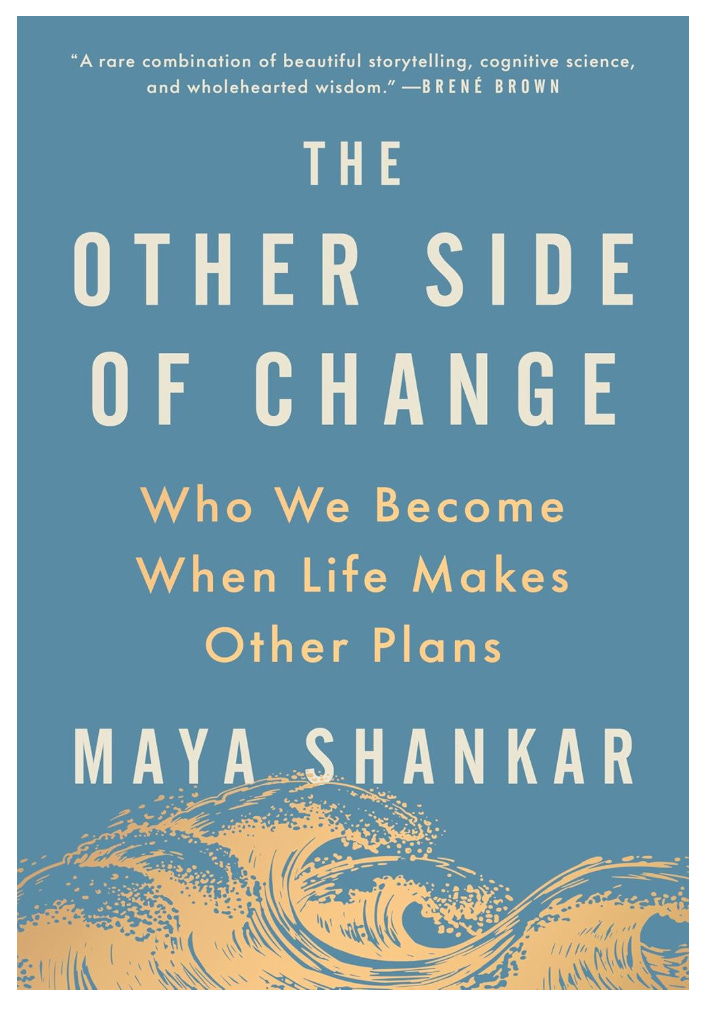
Chris: Your book comes out today, January 13th. Can you tell us a little bit about it?
Maya: I’m so excited for people to read The Other Side of Change, because I took a very different approach than I do with the podcast. On A Slight Change of Plans, I get 90 minutes with someone. For the book, I spent hours upon hours with each person, interviewing them multiple times over a span of several years.
When you engage at that level of depth, you can better contextualize a person’s change, to understand why they responded as they did or grew as they did. It was an honor to spend so much time in conversation with people, revisiting their past, engaging with their present, and anticipating their future —and witnessing their evolution even over the course of our interviews.
I’m incredibly proud of this book, and I really hope it helps people navigate the messy waters of change. It really changed my life to write it. The greatest challenge for me was figuring out how to pair the wisdom from people’s stories with concrete, rigorous science, so that readers also walk away with practical tools they can use in their own lives, no matter what change they’re going through. I think I delivered on this goal.
I’ll end by sharing that the overarching message of the book is one of hope.
When we anticipate how we’ll respond to a change, we falsely assume that we’ll be the same person from beginning to end. This psychological bias is known as the end of history illusion, and it captures the idea that our brains reliably underestimate how much we’ll change in the future, even though we recognize that we’ve changed considerably in the past.
A major disruption in our lives typically accelerates these internal shifts. When a big change happens to us, it can lead to profound change within us. Simply put, we become different people on the other side of change. For this reason, you may be able to endure a negative change far better than you think because you’re underestimating your own ability to evolve as a result of that change.
And so, the relevant question to ask yourself isn’t “How will I navigate this change?” but rather “How will I — with potentially new capabilities, values, and perspectives — navigate this change?”
By and large, the people I’ve interviewed over the years have felt gratitude and awe for the person they’ve become as a result of what they’ve been through.
Which is why, in this book, I challenge my readers to rethink their relationship with change altogether:
What if we started to see the big disruptions in our lives as a chance to reimagine ourselves, rather than as something to just endure?

To follow Maya Shankar’s work:
Read her book, The Other Side of Change
Listen to her podcast, A Slight Change of Plans
Subscribe to her newsletter, CHANGE With Maya Shankar
Great interview, Chris. Really looking forward to reading Maya's book.
Thank you for introducing me to Maya. I can't wait to read her latest book and found her insights and wisdom from your questions very relatable and, once again, thought provoking.
I love the why instead of what, the three forms of empathy and that we should expect that our internal values and perspectives would almost necessarily change as a result change to our circumstances.
Thank you again for another great interview.